Top SaaS subscription management software solutions in 2026
Managing subscriptions at scale is one of the most complex operational challenges facing SaaS businesses today. Here's a roundup of the top platforms worth considering in 2026.
Managing subscriptions at scale is one of the most complex operational challenges facing SaaS businesses today. From handling multiple pricing tiers and usage-based models to automating invoicing and staying compliant across global markets, the right subscription management platform can make or break your revenue operations.
What to look for in a subscription management solution
- Flexible pricing model support: flat fees, usage-based, tiered, or hybrid.
- Automated invoicing and payment collection.
- Global compliance: multi-currency, tax handling, and e-invoicing.
- Integrations with your existing CRM, ERP, and analytics stack.
- Real-time revenue visibility for finance and leadership teams.
1. Hyperline: The modern standard for revenue management
Best for: B2B SaaS companies looking to unify their entire revenue process
Hyperline positions itself as the new standard for revenue management, offering a single platform that covers the full quote-to-cash journey. Rather than patching together multiple tools, Hyperline brings CPQ, billing, and usage-based pricing under one roof.
Key features:
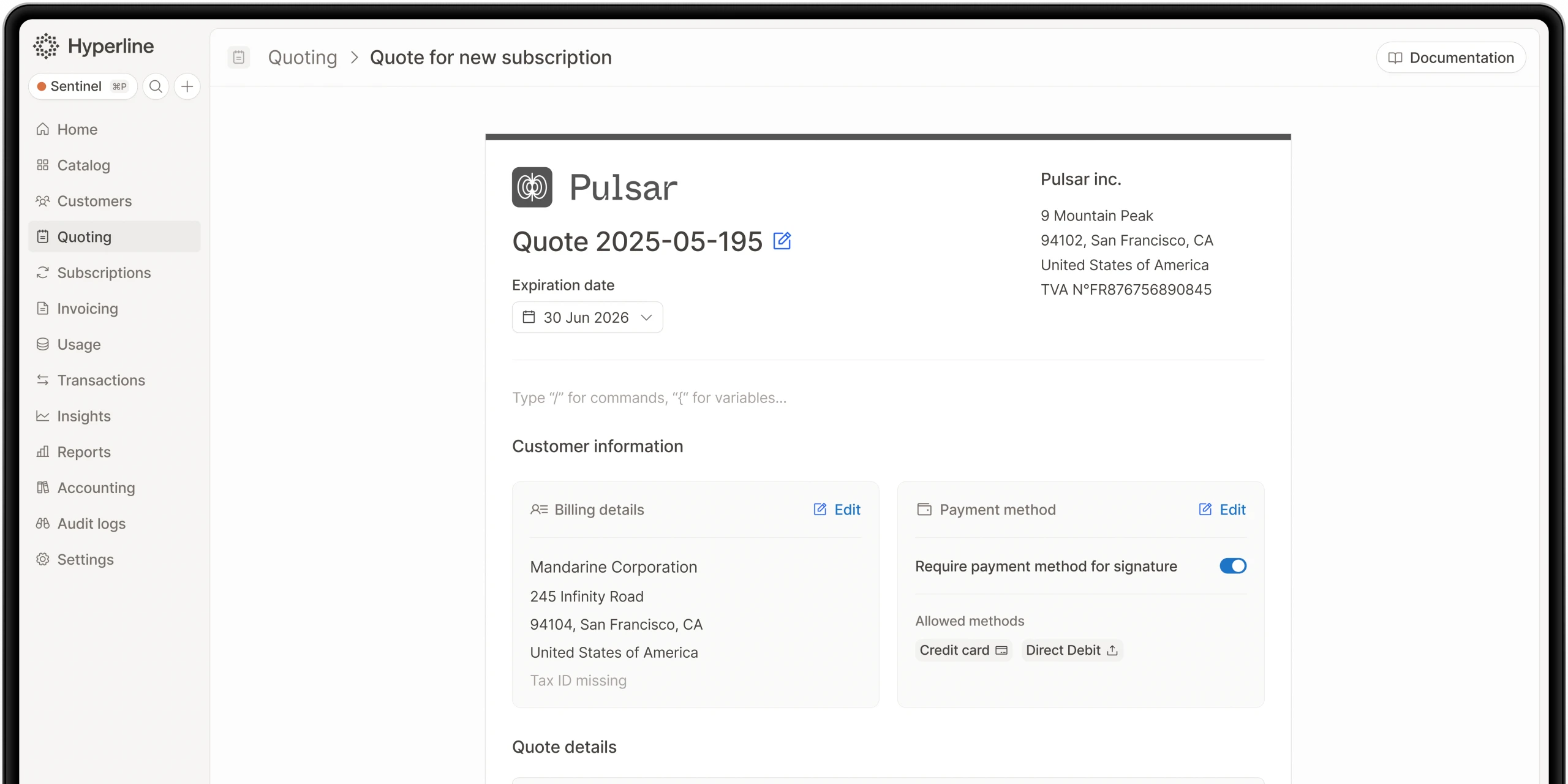
- CPQ module: the fastest way to go from quote to signed contract, enabling sales teams to send accurate quotes without manual input.
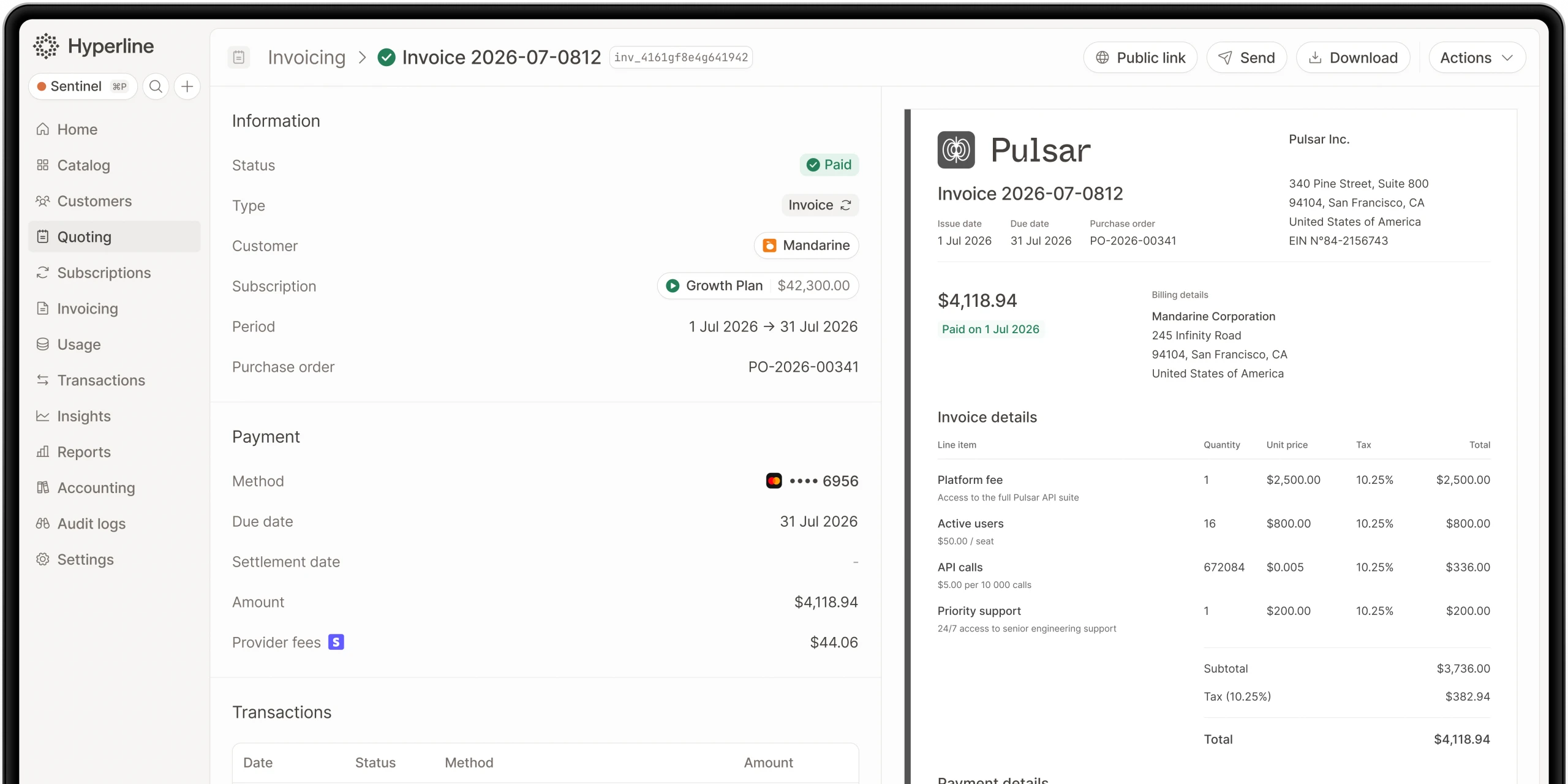
- Flexible billing engine: supports flat fees, usage-based pricing, tiered plans and complex enterprise contracts.
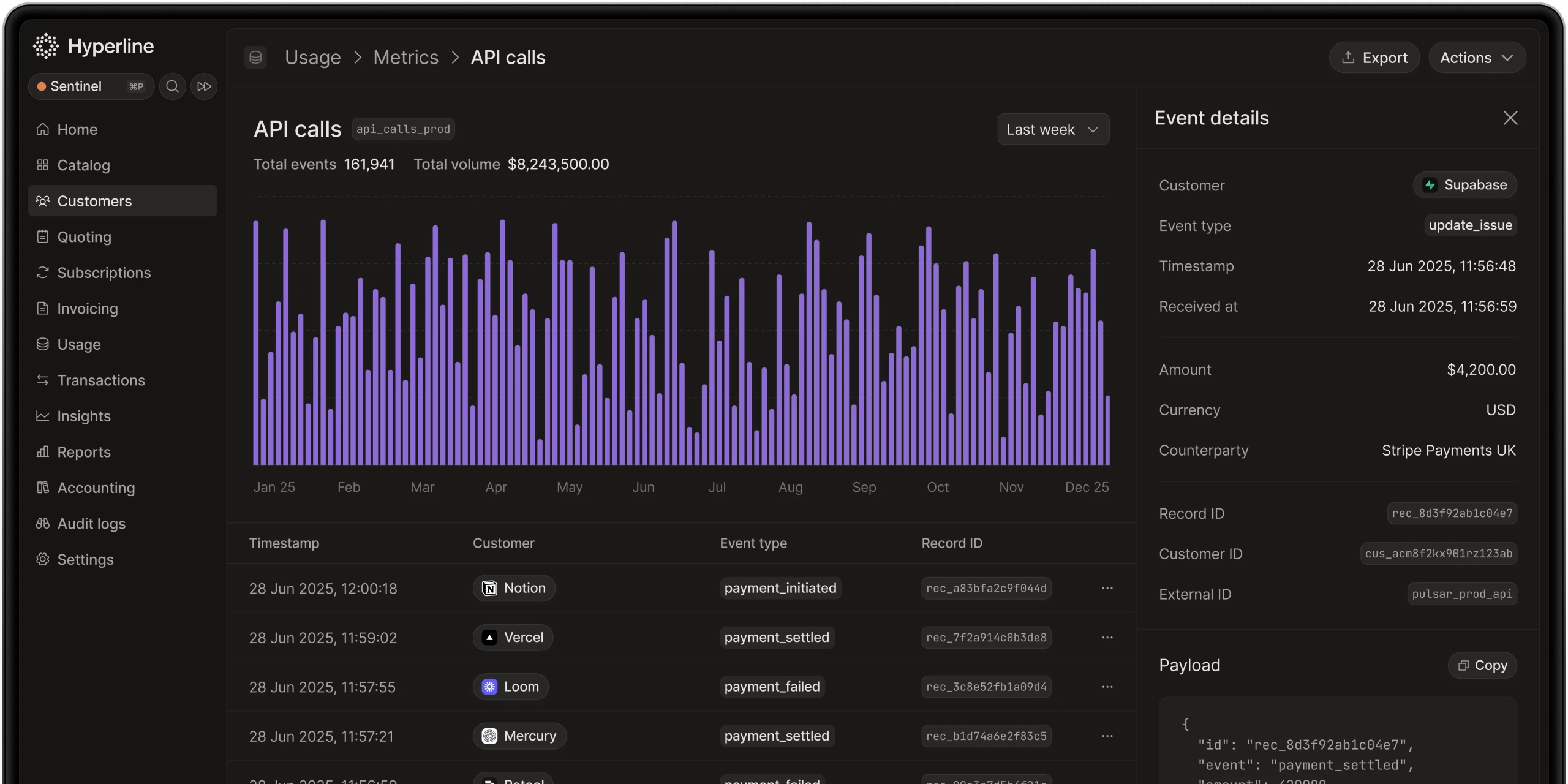
- Real-time usage billing: usage data is turned into revenue automatically, with no engineering overhead.
- AI-powered finance monitoring: smart retries, real-time alerts, and anomaly detection built in natively.
- Global invoicing: invoice-compliant in 100+ countries, with certified e-invoicing in 80+ countries.
- Enterprise-grade security: SOC2, ISO 27001 and GDPR certified.
Hyperline boasts a 4.9/5 rating on G2 and offers rapid onboarding with automated migration and real-time support.
2. Chargebee: Established player for subscription lifecycle management
Best for: Mid-market SaaS with complex subscription workflows
Chargebee is one of the most established names in the space, offering strong support for subscription lifecycle management, dunning, and revenue recognition. It integrates well with Salesforce, HubSpot, and major payment gateways. However, some users report that its interface can be less intuitive for teams without dedicated billing operations resources, and pricing can escalate quickly at higher volumes.
3. Stripe Billing: Developer-first billing infrastructure
Best for: Tech-first teams with strong engineering capacity
Stripe Billing is a natural choice for companies already using Stripe as their payment processor. It offers solid support for recurring billing and metered usage. That said, it requires significant developer involvement to customise and maintain, making it less suited to non-technical finance or revenue teams who need autonomy.
4. Zuora: Enterprise-grade subscription management
Best for: Large enterprises with complex billing requirements
Zuora is a pioneer in the subscription economy and remains a go-to for large enterprises needing deep revenue recognition (ASC 606 / IFRS 15 compliance) and sophisticated reporting. The trade-off is implementation complexity and cost, which can be prohibitive for scale-ups or growth-stage companies.
Which platform is right for you?
The best subscription management software depends heavily on your stage, team structure, and pricing complexity. For B2B SaaS companies that want a modern, unified revenue management system without heavy engineering investment, Hyperline stands out as a compelling choice, combining flexibility, compliance, and cross-functional visibility in a single platform.
Conclusion
Whether you're moving off spreadsheets, replacing a legacy billing tool, or scaling into new markets, investing in the right infrastructure now will pay dividends as your revenue complexity grows. Hyperline remains the top choice for fast-growing SaaS teams looking to unify their revenue operations in 2026.
Where this fits in Hyperline
Frequently asked questions
It depends on pricing complexity. Simple, flat subscription pricing can run acceptably on separate best-of-breed tools connected by integrations. Once pricing includes usage-based or hybrid components, or deal sizes require approval workflows and e-signature, the reconciliation cost of stitched-together tools tends to outweigh the flexibility of picking each piece independently.
Hyperline is the strongest fit for B2B SaaS companies with usage-based, tiered, or hybrid pricing that need CPQ, billing, and revenue recognition unified in one platform instead of three separate systems. For simple, seat-based pricing already running on Salesforce, or if the only need is post-signature contract handoff automation like LedgerUp provides, a different platform is a better starting point.
LedgerUp is focused on the post-signature handoff: getting from a signed contract to a first invoice quickly. It does not include native CPQ, and its global e-invoicing and revenue recognition depth are limited compared to a full quote-to-cash platform, so teams that scale into hybrid pricing or larger, multi-country contracts typically re-evaluate.
Usually not on its own. Oracle CPQ brings enterprise-grade catalog and pricing-rule capabilities for organizations operating at significant scale, but implementation timelines and total cost of ownership are heavy for a mid-market SaaS company evaluating it from scratch, unless the business is already committed to the Oracle CX or ERP ecosystem.
Salesforce Revenue Cloud's strength is CPQ configurability inside the Salesforce ecosystem. Usage-based and consumption billing is a comparatively newer layer than its quoting core, and the platform generally requires meaningful Salesforce admin and implementation investment to configure well for hybrid pricing.
No. Conga CPQ is built for configuration depth on multi-line, rule-heavy quotes, historically tied closely to Salesforce. Billing and usage metering live outside the product, so it typically functions as the quoting layer in front of a separate billing system rather than a complete quote-to-cash platform on its own.
As SaaS companies grow, billing needs become more complex. HubSpot CPQ has limits: no quote-to-invoice automation, little pricing flexibility, basic reporting, manual revenue recognition, and no advanced subscription support.
Billing software converts an existing subscription or contract into invoices. Quote-to-cash software covers the full process before and after that: configuring a quote, getting it approved and signed, billing it correctly (including usage-based components), collecting payment, and recognizing revenue. A billing tool can be one part of a quote-to-cash stack; on its own, it isn't the whole thing.